

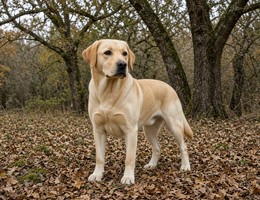
Labrador Retriever

Labrador Retriever
Size: Large
Other Names: Lab, Labrador, Labby
Country of Origin: Newfoundland and Canada
Accreditation:
American Kennel Club (AKC): Sporting
Canadian Kennel Club (CKC): Sporting
United Kennel Club (UKC): Gun Dog
Australian National Kennel Council (ANKC): Gun Dogs
The Kennel Club (KC): Gun Dogs
Kennel Union of Southern Africa (KUSA): Gun Dogs
National Kennel Club (NKC): Recognized
New Zealand Kennel Club (NZKC): Gun Dogs

The Labrador Retriever is a medium-sized, powerfully-build dog, with a short, dense, water-resistant coat.  His skull and powerful muzzle are approximately equal in length, with brown or hazel triangular-shaped, medium-sized eyes, a black or liver-colored nose, and triangular-shaped, short, drop ears.  His straight, powerful tail is a distinctive feature of his breed; a natural extension of the topline, very thick and muscular at the base, and tapering to the tip.

A short-coated retrieving dog for an active house; little grooming beyond shed, a generally friendly voice, and daily swim or fetch time rather than idle apartment hours.

The Labrador Retriever is a type of gun dog, that became prized as a sporting and waterfowl hunting dog.  The early Labrador originated on the island of Newfoundland, now part of the province of Newfoundland and Labrador, Canada.  The breed emerged over time from the St.  John's Water Dog.  Their interwoven coat is relatively waterproof, and they are excellent swimmers.  With training, the Labrador is one of the most dependable, obedient, and multi-talented breeds in the world.  He is the most popular breed of assistance dog in the United States, Australia, and many other countries.  The steady temperament of Labradors, as well as their ability to learn, make them an ideal breed for hunting, tracking and detection, Search and Rescue, disabled-assistance, carting, and therapy work.  Approximately 60-70% of all guide dogs in the United States are Labradors.  Based on their genetic makeup, puppies of all colors can potentially occur in the same litter.
Height
Male: 22-25 inches; Female: 21-24 inches
Weight
Male: 65-80 pounds; Female: 55-70 pounds
Color
Black, chocolate, or yellow
Coat
Short and dense, but not wiry; oily (waterproof)
Lifespan
10–12 years
Litter size
6–8 puppies

Temperament

The Labrador Retriever is exceptionally affable, gentle, intelligent, energetic, well-balanced, and good natured.  Labradors are a great family dog, and are considered good companions for people of all ages.  They have a high level of patience and tolerance for children.  They thrive on human attention, affection, and interaction.  They are not prone to being territorial, pining, insecure, aggressive, destructive, or hypersensitive.  As a rule, they get along well with other animals.  They are excellent retrievers, and they instinctively enjoy holding objects, including hands and arms, in their mouths, which they can do with great gentleness.  Almost every Lab loves playing in water or swimming.  Females may be slightly more independent than males.  Labradors mature at around three years of age; before this time they can have a significant degree of puppyish energy, often mislabeled as being hyperactive.  Generally, Labs are not noisy, but will sometimes bark when there is noise from an unseen source.  Because they are often very easygoing and trusting with strangers, Labradors do not make good guard dogs.

Training

With training, the Labrador is obedient and dependable.  He responds well to praise and positive attention.  He can be somewhat boisterous if untrained, and this fun-loving boisterousness and lack of fear can be quite problematic as an uncontrolled adult.  Because of his enthusiasm, early leash-training is suggested to prevent him from pulling when full-grown.  Labradors are prone to chewing objects, but can be trained out of this behavior.

Care and grooming

Labrador pups should not be brought home before they are 7–10 weeks old.  Labradors have a lot of energy, and require regular, daily exercise.  They often enjoy retrieving a ball endlessly, and other forms of activity, such as agility, frisbee, or flyball.  Labradors have a well-known reputation for appetite, and some dogs may be highly indiscriminate, eating digestible and non-food objects alike.  They are persuasive and persistent in requesting food.  For this reason, the Labrador owner must carefully control the dog's food intake to avoid obesity and its associated health problems.

Shedding

Moderate; the short double coat sheds more in spring and fall.

Health

Labrador Retrievers may develop hip and elbow dysplasia, obesity, exercise-induced collapse, and progressive retinal atrophy.  Keep them lean; extra weight shortens this breed’s working life.

Creature.com  Copyright © 2015 - 2026 All Rights Reserved

Creature.com accepts no responsibility for the accuracy of the advertisements placed on the Creature.com website or for the contents of any website to which a hypertext link from Creature.com links.  The Seller Ads and links to products and/or services are provided as a service, and Creature.com gives no warranties, expressed or implied, about the information and/or policies of the Seller Ads or the linked-to webites, or of the information shown.

Creature.com is the sole owner of the services and of all information provided by and posted to the Creature.com website.  The use, reproduction, or storing of content for any purpose other than to contact a Seller, purchase a product or service, or compare prices is prohibited.  You cannot use the information provided by Creature.com to recreate a directory, rebrand the informaton or redistribute the information in any way.  Information provided by Creature.com is for individual, non-commercial use only.  All information, processes and content contained within and that make up the services are the sole property of Creature.com.  You may not reproduce, duplicate or redistribute any information provided by Creature.com for profit or personal gain of any kind.  You may not frame any content or pages contained within the Creature.com website unless expressly granted permission by Creature.com.